

No products in the cart.
Router Bit Guides
Woodworking Router Bits Guide: Choose the Right Cutter for the Job

09
Oct
Oct
Updated October 24, 2026 · Reviewed against manufacturer and safety references
Start with the cut you need. A groove, template edge, rounded corner, rabbet and dovetail each call for a different geometry. Then confirm the cutter diameter, shank, machine, workholding and material. This task-first approach follows the practical selection guidance from Trend’s router-cutter guide and Rockler’s beginner guide.
This is the broad map for woodworking router bits. It does not replace a tool maker’s product sheet. Use the linked specialist guides when you need shank sizes, cleaning steps, material choices or speed decisions.

Choose the cut before the profile name
| The job | Useful first choice | Check before buying |
|---|---|---|
| Groove, dado or shallow mortise | Straight or plunge-rated spiral bit | Cutting diameter, flute length and plunge capability |
| Copy a template or trim laminate | Flush-trim or pattern bit with a bearing | Bearing position, cutting length and template thickness |
| Soften a sharp furniture edge | Roundover or small chamfer | Radius, angle, bearing clearance and edge thickness |
| Cut a step for a panel or cabinet back | Rabbeting bit with the correct bearing | Rabbet depth and bearing kit |
| Make a mechanical joint | Dovetail, slot, lock-miter or finger-joint cutter | Jig, angle, depth and test-fit allowance |
| Add a decorative edge | Cove, ogee, beading or thumbnail bit | Profile size, router power and table support |
What the common profiles do
Straight and spiral bits
Straight bits remove material for grooves, dados and simple mortises. Use a bit marked for plunge work when the cut starts inside a board. Upcut spirals lift chips and clear deep slots. Downcut spirals press top fibers down. Compression cutters combine both directions for suitable sheet-good through-cuts.
Flush-trim and pattern bits
The bearing follows a template or finished edge while the cutter removes the overhang. Choose the bearing position to match where the template sits. Rough-cut close to the line first. Workholding still controls the result.
Roundover, chamfer and beading bits
These tools form an edge. A small roundover softens furniture edges. A chamfer creates a straight bevel. Beading adds a rounded detail. Make a test cut because the same nominal radius looks different on thin and thick stock.
Rabbeting, dovetail and slot cutters
Rabbeting bits cut a step for backs, glass and overlapping joints. Dovetail bits need a compatible jig. Slot cutters use an arbor and bearing for splines, panel grooves and T-molding. A test piece is more useful than a guessed dimension.
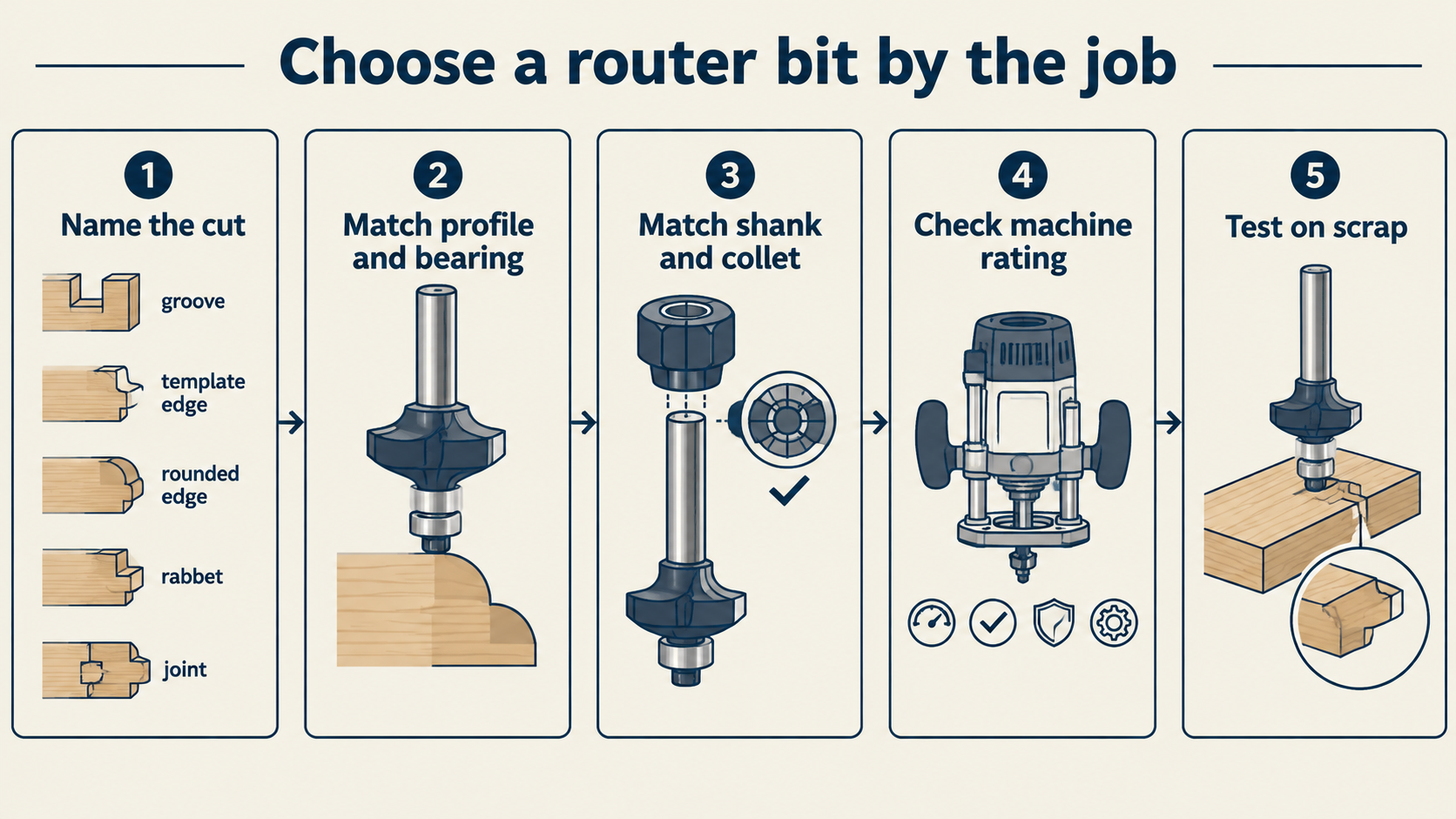
Shank and machine fit
The shank must match the collet exactly. A 1/4-inch shank is 6.35 mm, not 6 mm. A 1/2-inch shank is 12.7 mm, not 12 mm. Similar-looking sizes can slip or clamp unevenly. Use the shank-size guide before substituting a metric collet.
A larger shank can add rigidity when the router, collet and cutter support it. It is not automatically safer or cleaner. Many large profile cutters require a router table. Check the product sheet.
Material and cutter material
Carbide is common for hardwood, MDF, plywood and laminate because it resists wear. HSS can suit light softwood work and some specialty profiles. The carbide versus HSS guide explains the trade-off without claiming a universal life multiplier.
Safe setup in the workshop
- Inspect the carbide, body, bearing and shank.
- Use the correct collet and the machine maker’s required shank engagement.
- Support the work with a fence, jig, backing board or featherboard where needed.
- Choose speed from the cutter rating and widest cutting diameter. Use the speed guide as a test method, not a universal setting.
- Make a scrap cut before routing a joint or large profile.
- Wear eye and hearing protection. Add dust protection for fine MDF and CNC dust. CCOHS router safety guidance covers disconnecting power, securing the work and checking the tool.
Which guide should you read next?
Use this page as the map. Open the quick profile directory for a project-by-project choice, the material guide for sheet goods and hardwood, or the cleaning guide for resin and pitch.
FAQ
What should a beginner buy first?
A small straight or spiral bit, a flush-trim bit and a modest roundover or chamfer cover many workshop tasks. Add a profile when a project needs it.
Can I use router bits in a drill?
No. A drill is not designed to hold or control a router bit under side load. Use a router or CNC spindle rated for the cutter.
How deep should each pass be?
Use the cutter and machine maker’s guidance. Start shallower on scrap. Several controlled passes are easier on the tool and workpiece than one forced pass.
Sources and scope
Checked October 24, 2026. These sources support the general explanations above. Product ratings and machine manuals take priority. Do not transfer a number or operating limit from one model to another.
